We are using the hashtag#winterflakequiltSAL on the social media for all the pictures during this quilt-along.
This week it's all about the quilt assembly and with these large blocks, it will go very fast!
While my throw size was so easy to assemble, there are baby and bed size of the pattern that are assembled on the diagonal or "on-point" layout, so I explained a few possible troubleshooting issues in the video.
My quilt pattern testers mainly chose to create this small size and you can check out their versions HERE.
There's only one last week left where I will share with you my process of finishing the quilt.
We are using the hashtag#winterflakequiltSAL on the social media for all the pictures during this quilt-along.
This week we are here to finally start assembling the blocks and you can also find all the needed informations with diagrams on the page 9 in the pattern.
You will see how surprisingly easy it will be, now that we have all the quarters and inner borders assembled and have cut all the big, 12.5" squares and rectangles in fabric A.
I hope that you enjoyed this episode and that you have found something useful in my videos!
Hello and welcome to the 3rd week of our Winterflake quilt sew-along and thank you so much to everyone who participated in the Fabric + pattern giveaway!
As we assembled strips sets and have cut the strip units last week: this week, we are talking about quarter blocks making, which are needed to assemble the snowflake, I mean Winterflake blocks 1 and 2.
Here are the previous posts if you are catching up only now:
We are using the hashtag#winterflakequiltSAL for all the pictures during this quilt-along.
This week we are here to finally start assembling the blocks, I mean block’s quarters, that you can also find on the pages 6, 7 and 8 in the pattern.
You will see how surprisingly easy it will be, now that we have all the units cut and strip units assembled.
The basic, log cabin structure of quarters of quilt blocks 1 and 2 is a centre shape surrounded by strips, or “logs”. Use the table on the page 6 to create the requirednumber of blocks andinner border units for your quilt size.
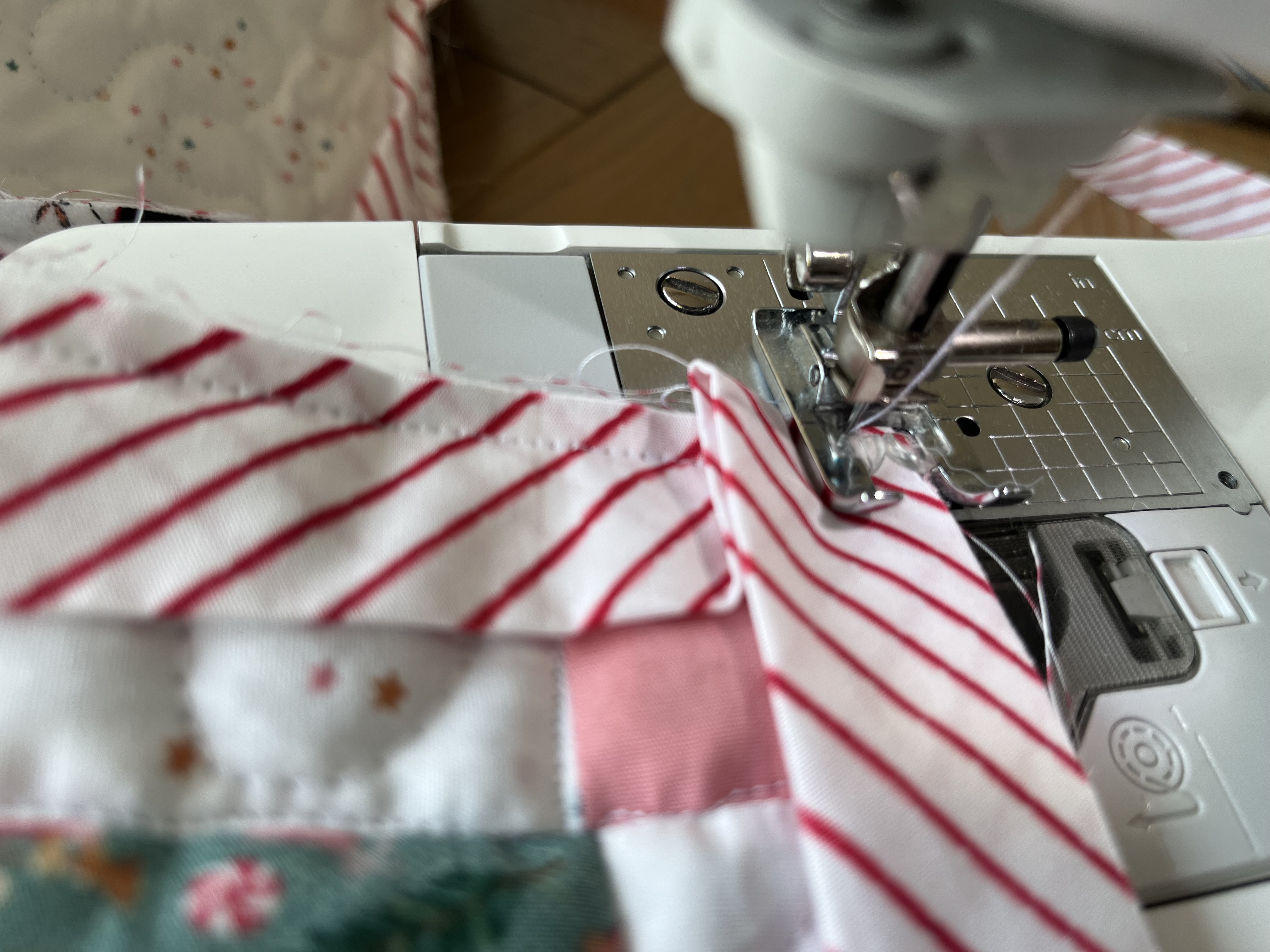
Using the diagrams provided in the pattern and paying close attention to the orientation of the Strip Set units, pin and sew logs.
We are starting with the simple 3.5” square in fabric C for the quarter 1, while
for the quarter 2, we are starting with the 3.5” square in fabric H.
We are making the quarter 1 in the video.
As you can see, the most important thing with sewing these log cabin structured blocks is to keep precise ¼” seam allowance, as with basically every quilt block.
I am sure that from this you can easily obtain all the blocks and assembly your quilt top too, but we will leave that for the next week.
I hope that you enjoyed this shorter episode and that you found something useful in my videos!
Happy 4th of July to all of you celebrating and see you next week!
Also, If you have your fabrics chosen already, please use the hashtag#winterflakequiltSALso that I can see your pictures and also use this hashtag for all the pictures during this sew-along so that they are visible for all the participants. This giveaway is open till Friday, June 30 and is open worldwide!
By using this hashtag and posting your picture, you become eligible to enter the giveaway on Instagram and hopefully win the prize that includes:
Here is the Winterflake quilt pattern SAL schedule with pages covered from the pattern:
Week One, June 19 - Prep: Choose + Cut Fabrics: page 1 and 2
Week Two, June 26 - Make strip sets: page 3, 4 and 5
Week Three, July 3 - Make Quarters : page 6, 7 and 8
Week Four, July 10 - Make Blocks: page 9
Week Five, July 17 - Quilt top assembly: page 10, 11 and 12
Week Six, July 24 - Finishing: page 14 and 15
Based on some questions I got I will quickly go through some basics of the prepping process again, just to be sure that I covered everything, even because I am so happy to be welcoming some beginner quilters aboard!
Preparing the fabrics to cut:
You got your fabrics and you are torn between prewashing or not?
There are different opinions about that and that’s where fabric quality also plays a big role, because obviously not all the fabrics will shrink the same way. But if you are using the fabrics from one manufacturer and they are all the same substrate, like in my case with all AGF fabrics that are all 100% premium cotton weight-I will not prewash them. If I would choose to use maybe the linen as a background fabric (which can be pretty amazing) which is 55% linen and 45% cotton and is a different fabric weight as well, I would definitely prewash it.
Fabrics are commonly woven and that involves the interlacing of two sets of yarns or threads at right angles to create a stable and cohesive fabric structure.
In the weaving process,the longitudinal threads are called warp threads while the horizontal threads are called weft threads are then woven over and under the warp threads to create the fabric. Not all the fabrics are woven the same way. Some of them are woven loosely and they don’t have the same thread count. So, if the fabric weaving is just not tight enough, it will definitely contribute to eventual bowing. That’s why most of the quilters suggest using the narrower stitch length while piecing, in order to straighten the fabrics additionally. In my case, as I am the AGF designer and I am lucky enough to be using only the AGF fabrics that are well known for their high thread count, I know that my fabrics will not be giving me these kinds of problems, unless my piecing is not perfect.
I would strongly suggest to nicely press fabrics before piecing and cutting (even though I must confess that I am not always doing that myself, if the fabric is not really wrinkled and creased).
I am using a steam while pressing my fabrics, while when there’s some piecing involved like with strip pieced sets, units and blocks, I don’t use the steam.
When pressing fabrics, I suggest to open them nicely and press from one selvage to another, releasing all the wrinkles and creases. I like to lay the next fabric on the top of the first one and I tend to make a nice batch like that with the fabrics that will be used for that particular strip set (usually 2-5 fabrics).
Once the fabrics are cooled down from pressing, I like to fold them and line up the selvages together.
Before pressing and cutting, please check your edges and make sure that you are cutting the fabric on grain.
Some tips for sewing the fabrics together accurately:
- clean your sewing machine, especially the feed dogs
- adjust your stitch length to 2 mm
- use the scant 1/4" seam allowance
- use the ¼” seam allowance presser foot
- use the magnetic seam guide
Sewing the strip sets:
In this quilt pattern, we are using the strip piecing techniquethat involves sewing together fabric strips to create fabric sets, which will be used to obtain some units.
In order to avoid any accidental bowing and fabric deformations, I intentionally put the length of my strip sets in this pattern to be 21” rather than 42”. First because there are people that will be using Fat Quarters and then because I think that it makes everything just easier and more precise. Especially for the baby and throw size. While maybe for the bed size, you would prefer using entire width of the fabric strips. But that’s up to you.
So let’s get started!
Take the first two strips from your prepared fabrics and place them right sides together. Align the edges and sew them together along one side using a quarter-inch seam allowance (I strongly suggest using scant seam allowance, like I said and shown in the video).
Making sure that fabric stays lined up, just sew with medium velocity, which would help controlling the piecing precision.
Off the sewing machine, press the seams either open or to one side (usually toward the darker fabric).I prefer having my seams open and I always use my fingers to press and set the seams, before using the iron.
Continue adding strips to the sewn unit, one at a time, in the order determined by the pattern. What may help here is also changing the directions of sewing the strips together, from up down and vice versal. Sew each strip to the previous one, aligning the edges. Press the seams open or to one side after each addition.
Once you have your strips sets all sewn and pressed, it’s time to make the units. Following the diagrams in the pattern, make the number of cuts from each set needed for the quilt size that you are making- just follow the table on the page 3 that determines the exact number of strip sets and strip units-subcuts.
When making the first cut, try to follow the grain and make a nice, crisp and straight edge, which will also serve as a guide. From that you can easily cut any needed strip sizes. But hopefully you watched my first video and saw that part already.
Let's see for example this strip set # 1. I am making the first cut by trimming off the edge. I am making attention to the middle seams and edges in the sets being parallel to the lines on my ruler and I am making the first cut at 3.5”, cutting the squares out from this first strip set. Following the table on the page 3, I will see exactly how many units I need to cut from each of the strip sets. In my throw sized version, I will need 16 units cut from both SS1: AD and AI.
So following the instructions and diagrams for all the strip sets, we will have strip sets 1, 2, 3, 4 and 5 done.
While cutting fabrics, you need to strongly press your ruler to avoid eventual shifting and moving, or try following the cutting path with your hand so that-portion, by portion, it would get nicely cut without ruler moving, which would result in getting wonky and uneven strips.
Try to use the guidelines from your ruler to obtain precise cuts, especially when cutting small, narrow strips and units.
After obtaining all your strip units, you are ready to make the block's quarters!
Hi there and huge WELCOME to my first ever QUILT sew-ALONG!
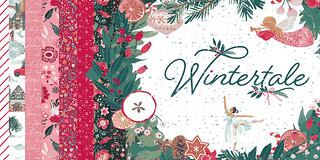
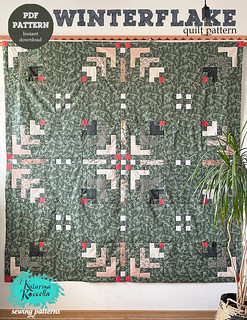
Last year, when I created and released my Winterflake quilt patternthat was featuring my Botanist fabric collection, the response was amazing and I am so happy to talk a bit more about it again, now in form of this sew-along event. What I am truly excited about is that I will be recreating this quilt pattern with my newest fabric collection - Wintertalethat is actually a Christmas collection and that’s why I love to see this sewing event as a sort of Christmas in July.
I am hoping that we can get to learn, share, and create together.
The Winterflake quilt pattern should be appealing to a wide range of skill levels although all my patterns are written for the beginner to advancedbeginner/intermediate sewer. The pattern has front and back cover and 18 pages, completed with many helpful diagrams.
Here is the Winterflake quilt pattern SAL schedule with pages covered from the pattern:
Week One, June 19 - Prep: Choose + Cut Fabrics: page 1 and 2
Week Two, June 26 - Make strip sets: page 3, 4 and 5
Week Three, July 3 - Make Quarters : page 6, 7 and 8
Week Four, July 10 - Make Blocks: page 9
Week Five, July 17 - Quilt top assembly: page 10, 11 and 12
Week Six, July 24 - Finishing: page 14 and 15
As everything is going to be posted through my Instagram and this blog space, you don't need any other sign-ups. You can eventually subscribe to my newsletter, but only if you wish to obtain some freebies, coupon codes and news (which can be pretty amazing too☺️).
So what will you need, alongside excitement of making something new in a good company?
You will need some fabrics and tools.
And you will need the quilt pattern, that can be purchased in my Etsy shop.
Here is the back cover of my Winterflake quilt pattern that has some great suggestions and basic information about tools, materials, techniques involved and quilt sizes.
To make the process easy, accurate and fast, most of the units necessary for the log-cabin constructed blocks are assembled with strip piecing technique.
So these are some of the techniques, or better say methods that we will be using and hopefully improving through the process of making this quilt pattern: strip piecing and log cabin block making.
Strip Piecing is a time-saving method and patchwork technique created by sewing multiple fabric strips together to create a composite unit (a strip set) that is then cut to obtain smaller,
multi-piece segments. Strip piecing eliminates the need to work with small, individual pieces of fabric. Prior to cutting your fabric into strips, it is important to check if the fabric edges are straight. To check the edges, fold the fabric in half, matching the selvedges. Start cutting strips after ensuring a straight edge at 90° between the WOF and the selvage. Having an accurate seam allowance is necessary for obtaining precise strip sets (SS), especially where multiple strips are sewn together.
I always suggest to read the pattern before starting to pick and cut the necessary fabrics.
While I have only PDF patterns available, there are some quilt shops that like to buy the printing license from me (available in my Etsy shop as well) and they print the patterns on paper to provide them for their customers that prefer to buy the paper pattern and the fabrics together.
Here are some quilt shops that have the fabric kits available:
Before, finally posting the video for you to watch, I just want to THANK you so much for joining me in this quilt sew-along event and I hope that you will enjoy sewing with me and other makers!
I can not wait to see your creations!
Please feel free to contact me with any questions, suggestions or comments either here or on Instagram.
Although most of you will watch the video only, I thought I should also include some captions from the video, maybe they can be helpful too, as I am sure that there are parts in the video where my English could sound confusing. And sometimes I might try to explain something, only by bringing more confusion 😅, so if that was the case, here are maybe some better explanations.
Choosing fabrics
Whilechoosing fabricsfor quilts for some people can be the best and most exciting part, this process can be pretty challenging and sometimes even overwhelming for some others, so that’s why fabric kits and curated fabric bundles can be pretty good option for starting and planning to make the new quilt pattern. Another fabric testing option can be the coloring page that most patterns have and in this pattern it is on the page 13.
The most basic and safe option when choosing fabrics for a quilt project is being guided by the contrast, especially with the quilt patterns like this one with lot of negative space, where there’s very distinctive line between the background and the foreground (or the shape-figure that is created by the block). The contrast basically means “difference” and that means that you will have your blocks pop against the background when selecting contrasting fabrics. The most common contrast is light-dark and warm-cool colors.
This quilt uses combination of 11 fabrics - 1 for the background and 10 for the blocks body. From these 10 colors, each of 2 snowflake blocks has 4 unique colors- 3 for the 90 degrees shapes and 1 for the central, inner borders. One snowflake in my case features warm tones while the other is in cold tones, but this doesn’t have to be your case. The snowflakes shares the colors for little squares that are concentrated in the center and in the block’s corners for the block 1 and 2, while they are just centrally displayed for the blocks 3 and 4. In my case they are white (as my background is rather dark) and Sedona red. In my Wintertale edition that I will be making now, they are solid red and pink (as my background is white with just tiny accents featuring small stars) while all other fabrics are rather with prints from the collection.
If you are using just 2 to 4 colors, I think that you can’t really go wrong sticking to the contrasting colors, while if you are choosing 11 colors, like determined in the pattern, what I can suggest is to first choose 2 different, distinctive colors that you like the most for the snowflakes (in this Christmas version they would be red and green), then choose other 2 tones for each snowflake that are going to be distinctive by value, meaning that they will be a little bit lighter or little bit darker, so that you can finally obtain 3 shades that will gradually become either lighter or darker. It doesn’t really matter the disposition of those shades, from centre toward the edges or vice a versal – I actually did both, as you can see, as I couldn’t decide myself;)
Cutting fabrics:
I am always using full width of fabrics (WOF), folded once in half so that I can use my 23” ruler for cutting the fabrics first into the strips and then into any needed subcuts. I strongly suggest you to cut the WOF strips first from the yardage, by the order determined in the table: largest strips first (in this pattern they are 12.5" x WOF), going toward the smallest (2" x WOF in this pattern). After cutting all the WOF strips, submit them into smaller units: rectangles and squares. As we are making many strip-sets, that's why many rectangles are rather long-21".
On the fabric requirements and cutting directions page is the table including yardage and subcuts given for all 3 provided quilt sizes. I am using the whole width of the fabric (WOF), which is usually 42” for American fabrics (and that’s the standard for determining cutting requirements), nevertheless AGF fabrics have the 44/45’’ width. I know that there are many of you preferring to use subcuts, like Fat Quarters and if you might ask me if this quilt pattern is FQ friendly, I would say no, unless you would be doing some sort of scrappy version, at least regarding the background which is quite dominant in this pattern. You may use the fat quarters to replace all the 1/4 yard cuts or less, while you can use 2 fat quarters where the 1/2 yard of the fabric is needed, if that makes any sense.
So lets try to look better at this table and demystify the biggest and longest in subcuts needed list, fabric A or background requirements. Even because in all other fabrics you will meet the same sized strips and other subcuts.
The first line gives the yardage needed for each of the sizes. As I am making the throw quilt, I will need the total of 4 ½ yards in fabric A for the background. From that yardage, I will first cut all the needed WOF strips.
If you look at the pink blush fields standing out a bit, these fields are reserved for all the different in length strips x WOF. So we have 12.5” x WOF, 6.5” x WOF, 4.25” x WOF, 3.5” x WOF and lastly 2” x WOF. Then under these pink fields there are furtherly determined the subcuts from each of these strips.
So, for the 12.5” x WOF for the throw size I need 7 strips. From these 7 strips, I will need to cut 8 rectangles measuring 12.5”x 16.25”, 8 squares measuring 12.5” and 4 rectangles measuring 12.5” x 2”. Here we will have some leftovers that will be used for the smallest, 2”x 11" or 10” subcuts.
From two 6.5” x WOF strips I need to cut 4 rectangles measuring 6.5” x 21”.
From two 4.25” x WOF strips I need to cut 4 rectangles measuring 4.25” x 21”.
From four 3.5” x WOF strips I need to cut 8 rectangles measuring 3.5” x 21”.
From fifteen 2” x WOF strips I need to cut 22 rectangles measuring 2” x 21” and 36 rectangles measuring 2” x 11”(actually there will be 32 rectangles measuring 2” x 21” as four of these can be cut to 2” x 10”). These 2” x 10” are needed for the strip sets 5, to save on fabric, for the baby and throw quilt size options.
And lastly, as promised, here are some of the mock-ups with fabric selection (you will find the precise requirements for each of the fabrics in the pattern):
THROW size:
in case you are wondering how it would look if only switching blocks 1 and 2
Here are a few BED sizes, with on point layout:
If you have your fabrics chosen already, please use the hashtag#winterflakequiltSALso that I can see your pictures and also use this hashtag for all the pictures during this sew-along so that they are visible for all the participants.
By using this hashtag and posting your picture, you become eligible to enter the giveaway on Instagram and hopefully win the prize that includes:
Hi! I'm proud mama of 3 gorgeous kids that are true inspiration for my work. I love to create and express myself through many forms of art: collages, drawings, illustrations, calligraphy, graphic design, textile and surface design, printing, photography, sewing.....







.jpg)


%20(1).jpg)
























 GRID
GRID
 DECADENCE

















 Posts
Posts

