. . . . . . . . . . . . . . . . . . . . . . . . . . . . . . . . . . . . . . . . . . . . . . . . . . . . . . . . . . . . . . . . . . . . . . . . . . . . . . . . . . . . . . . . . . . . . . . . . . . . . . . . . . . . . . . . . . . . . . . . . .

Friday, 26 July 2019

Origami 3D pinwheel quilt block tutorial


Hi there!
Every new fabric collection I create, makes me think about the projects that would be most suitable to show off my intentions, to gather the inspiration with the final products.
In a quilt-y way of thinking (thinking geometrical;), I wanted to create some blocks that would be easy to make and yet very joyful and summery.
And what better way, than doing the pinwheels, right?

Firstly, I wanted to make these fabric pinwheels.
But, then I realized that I would prefer having them as quilt blocks.


Pinwheel blocks are fun, but even better if they are uncommon and 3D!!!


So, I found several tutorials and videos by browsing the internet for these blocks, and at the end, I decided to gather here my step by step pics of creating these blocks, as they are easy and fun to make!

So, let's get started!

Tools/materials:

- sewing machine
- cutting mat
- scissors, rotary cutter
- rulers
- thread, needle (quality thread and needles)
- iron and ironing board
- pins and/or clips
- fabrics: 3 different prints, 1 fat quarter of each
- batting (cotton or cotton blend)

Prints I used are from my Floralish fabric collection for Art Gallery fabrics:

fabric A: FSH-27407  Citrus Tangerina
fabric B:  FSH-27402  Seed of Iris fabric C: FSH-27406  Dancing Fortunella


Prepare and cut the fabrics:

1. Cut all 3 prints in 5" x 5" squares, so that you have:

-16 (sixteen) 5" x 5" squares in fabric that will be the base for the pinwheels (fabric A)
-8 (eight) 5" x 5" squares in fabric that will be for the pinwheels (fabric B)
-8 (eight) 5" x 5" squares in fabric that will be for the pinwheels (fabric C)


2. With squares from the fabrics B and C make the Half Square Triangles (HSTs):

Place and align two squares of two different fabrics (fabric B and C) right sides together and with a marker or pencil draw a diagonal line across the wrong side of the fabric. Sew a 1/4" seam on both sides of the drawn line. Cut the unit in half along the drawn center line. Open and press the units with wrong sides facing inside, hiding seams inside.
In this way, you will obtain two HST’s from each unit and will have 16 folded triangles.


3. Trim the folded triangles to 4", as shown in the picture, to get rid off the dog ears and get all nice and precise triangles.


*As you will obtain 4 pinwheel blocks that are double sided, at this point, you can choose if making them so that they have all the same fabric as main, or using both fabrics as main- so that you have 2 pinwheels in fabric B as main and 2 pinwheels in fabric C as main. Another thing that you can play with is the direction of the pinwheel: it can be in clockwise direction or counterclockwise direction.


4.  Place the folded triangles on the background squares, so that the folded diagonal of the triangle is parallel with the square's diagonal line. Pin or clip to obtain all 4 block units, so that they are forming the shape of the pinwheel. Secure the pinwheel triangles with stitches-using the narrow seam allowance ( a bit less than the 1/4"-approximately 1/8″ from the edge of the fabric ) the both sides where triangle is laying.  


5. Complete the steps until you have all 16 units completed and ready to assemble into a quilt blocks.
Take care that you are sewing each folded triangle in the same, desired direction.   


6. Sew the two and two units together of each block, using the 1/4" seam allowance ( so that your previous stitches are within the new stitched lines). The folded triangle areas are very bulky, so sew carefully. Finally, join the pairs together into a quilt block.


Press the units flat before opening to set each seam. Open each unit and with your iron press the seam allowance either open or to one side, upon your preferences. Pressing the seams open eliminates bulk and makes it easier to match the seams.  

Your blocks are finished and you can use them for any kind of quilty projects - from pillows and table runners to quilts, or eventually as detail for some kitchen accessories. 


I made the pillow with contrasting fabric piping ( from my Mediterraneo fabric collection) and loved it!!!!


Happy sewing!!!
Katarina

Thursday, 25 July 2019

Floralish fabrics

3x6 banner

My newest collection, Floralish is finally out and is shipping to stores!
It was inspired by summer and is filled with delectable fruits and stunning flora, beautiful blossoms with a fusion of watercolor textures fused with fresh and sweet tones.

Here's my mood board for the collection ( all the pics are not mine, but are taken from Pinterest) and my color palette.


And here are the prints from the collection:


I created a few things with these fun prints, and here's my favorite-Summer solstice quilt pattern:


I have the pattern available in my Etsy shop:

Summer solstice quilt pattern and to celebrate it,  I activated the coupon code: FLORALISH (30% off).


I hope that these prints will inspire you to create something bright and joyful for you and your loved ones!!!
Happy summer,
Katarina

Wednesday, 6 February 2019

The Splendid Sampler 2- my Coastline Sponge cake quilt block


Hi and welcome :)
I felt very honored and excited when Pat Sloan and Jane Davidson invited me to be one of the 80 featured designers in their wonderful Splendid Sampler 2 book and therefore to create a quilt block for that opportunity. It was really wonderful experience I gained in this collaboration, and I am beyond amazed by incredible talent, professionalism, kindness and generosity by our hosts and all designers participating in this project!

I was also delighted when I got my copy of the book-beside wonderful blocks, there are a few pages by the end of the book, explaining some quilting basics and many different techniques used for certain blocks, like embroidery, appliqué, curved piecing, English paper piecing, Foundation piecing and more!


Soooooo, I am so extremely happy that today is my day to share more about my quilt block from the book named: Coastline Sponge cake, that can be found on the page 39 of the book.

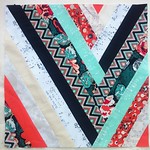
For my block inspiration, I started with my favourite  traditional quilting technique: strip piecing! Added to that were some nature and food details so hence my statement:
"Strip piecing always reminds me of baking a cake, with layers of yummy ingredients (here fabrics) placed together. The shades of these fabrics are the colors of the coastline and the sea, recalling my best childhood memories of vacations spent by the seaside, eating my favourite sponge cake".


The colors of the fabrics and thread sent to me from their sponsors: Moda and Aurifil were matching my inspiration nicely, so here are a few shoots of the original block, created for the book and to match other designers blocks when joined together in a big quilt.


As a fabric designer for AGF, I had to try the block in some of my fabrics. 
My latest fabric collection, Grid was calling me and I took some step-by step pics while re-creating  the block.


There are 5 different fabrics needed for my block. For nice shading effects-I suggest using different valued fabrics for the strip piecing units.


For the best results, I strongly suggest using the 1/4 seam allowance foot for precise piecing and also pressing fabrics with open seams after each of the steps.

Love matching seams!!!


I really enjoyed making this block and hope that you will try it and have fun with it, too and also entered it in the giveaway pool (details to follow;)!
 Here's my page from the book:


And speaking about the giveaway, for this special day, I decided to giveaway 3 of my quilt patterns, to one lucky winner!!! All you need to do is to leave a comment here, under this post and I will randomly choose a winner by the end of this week, on Sunday, February 10th, by 10 pm, Central European time, open worldwide. You can leave any comment you like, but don't forget to leave your e-mail, so that I can contact you, if you will be my Random Pattern winner.
They patterns can be chosen  from my Etsy shop:

And, another great giveaway for you is coming directly from my amazing AGF team , who is this week's sponsor on Sample Spree blog and they will be giving away one entire FQ bundle of my newest range - GRID fabrics, just like those I used in my block:) 
For this FQ bundle giveaway, you must make my block and share the photo of the finished block to be entered in the giveaway directly on the Splendid Sampler website!!!


You can also visit and join the Splendid Sampler's official Facebook group for more fun!!!
Please make sure to visit the official Splendid Sampler website regularly to get more info about the projects, blocks, tips, and giveaways too!!
Thank you so much for visiting and good luck!!!
xx
Katarina

___________UPDATE__________

We have a pattern giveaway winner!!!

Thank you so much to everyone participating, the random winner is number 15, Jill, that has been contacted via e-mail!!!!


Tuesday, 5 February 2019

Podcast guest on "While she naps"


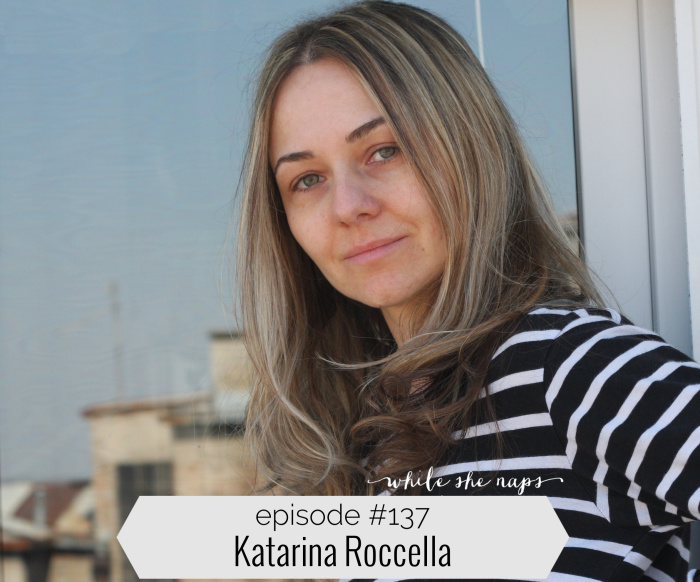
A few weeks ago, I had a great pleasure being Abby's guest, on her While she naps podcast.
If you might be interested to hear more about how I became fabric designer and more about my life in general, just tune in! You also, might be surprised with how many times I said "you know", and "actually", but I suppose it's ok when you are speaking foreign language.
Huge thanks to Abby Glassenberg for having me-I really enjoyed!!!
xx
Katarina

Tuesday, 29 January 2019

GRID fabric collection


My newest collection, Grid is finally out and I couldn't be happier with it! It's a great addition to my PhD project and I can't wait to use it the way I imagined ;) Hopefully will be able to show something soon....


But let me tell you a bit more about the concept I had in mind for this collection...
Numerous social and technological changes throughout the twentieth century, led to new researches and experimentations, interlacing and reviewing basic concepts in art, and the art itself. With implementation of the media in the arts, especially at the beginning of the second part of the twentieth century, there started to appear new artistic practices and movements, some as a revolt on the traditional way of seeing and understanding art, some as bunt on aestheticized, spectacle reality, and some as an attempt to bring art to a zero point, to review and clear art of any narrative and discourse, in order to widen the field of perception and give space to originality, in accordance with the changed social and cultural conditions.  
One of the most important visual art structures, which largely defines the art of XX and XXI century is certainly a grid, that within the contemporary art in the era of multiculturalism and globalization, introduced a new reality and inaugurated some of the most important movements of the twentieth century, including minimalism, pop art and op-art. 

Modern grid, as appeared in the works of artists of the twentieth century, owes much to the history of textiles, especially in the field of tapestries, carpets and quilts. *The grid and its contemporary manifestation, the matrix, continue to influence the work of artists, especially contemporary artists that weave or use concepts of weaving in their work. It is quite possible that computer programming evolved from the art of hand weaving, the first known binary code being warp and weft. The formal advantage of a digital Jacquard loom is that because of the ability of the software to assist the weaver in realizing much more complicated designs it is possible to embed more irregular structures into the cloth as well as symbols and images the artist chooses to include. These choices can vary from super abstract or simple structures and shapes to actual reproductions of photographs in textile form. Although a weaving emerges from the grid, part of the way cloth rebels against the idea of a dependable structure is its inherent ephemeral quality. 

Ideas like the matrix and the grid are used to name not only the un-imaginable reaches of space but also the unseen interiors of our own bodies. The grid and the matrix continue to be viable starting points for contemporary artists to explore the possibilities these structures hold to imagine the visible and the invisible and the connection between body and mind.  
In modern life, the grid is everywhere. Butterfly scales form the most beautiful and unique grid, the streets of cities create the most famous urban grid in the world, while we follow our digital media through small pixelated display network.  
*Partly taken from: 

Grid by Katarina Roccella
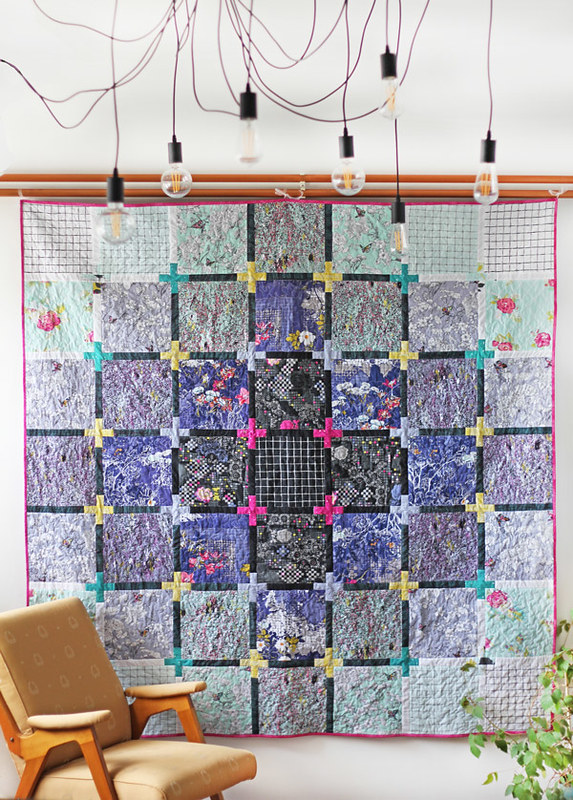
I am so proud of the free quilt pattern-Megapixel quilt that also can be found in the beautiful look book created by AGF team.


I particularly enjoyed making this beautiful tunic dress with rayon for my youngest daughter.
I certainly hope that this collection may inspire you to create too!!

xx
Katarina